
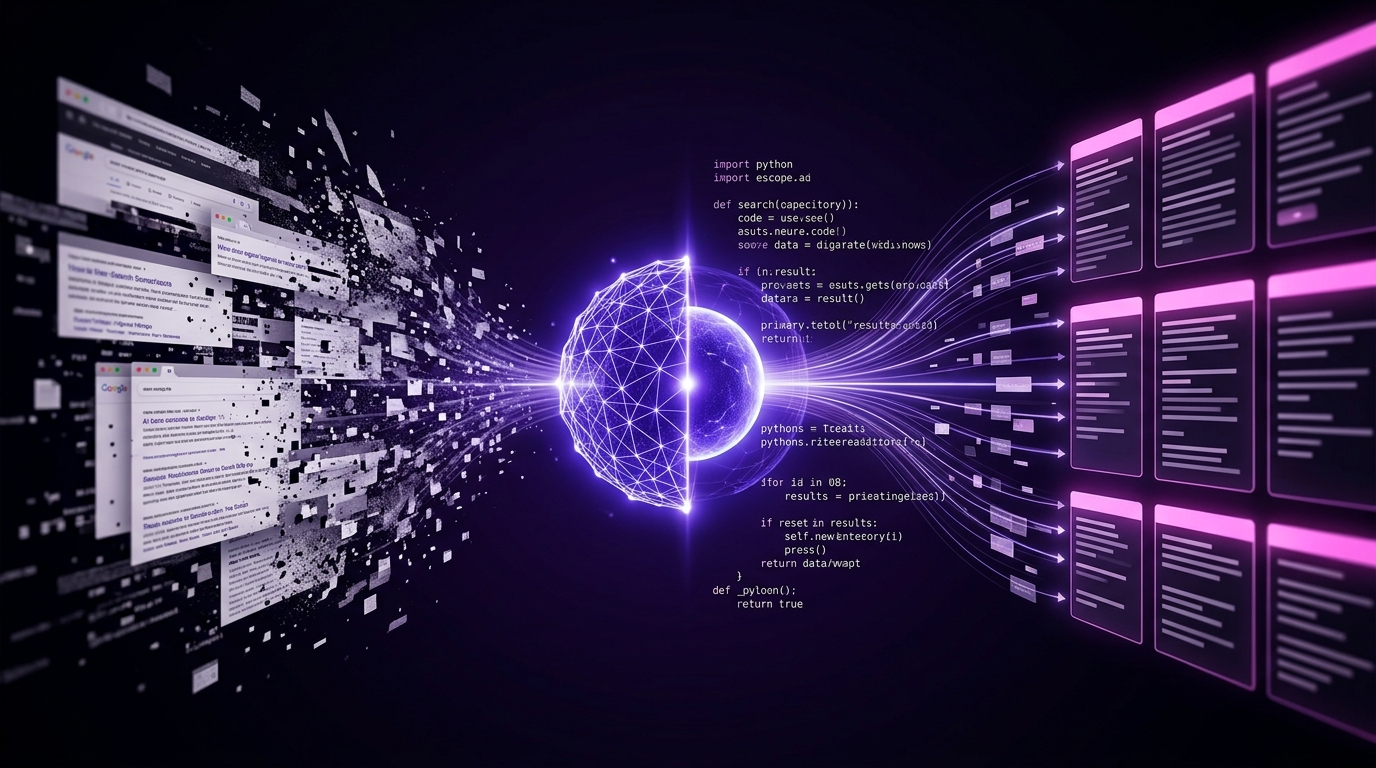
Perplexity, one of the world's fastest-growing AI search engines, recently published a technical manifesto that reaches well beyond a product announcement. Its thesis: the way AI agents search for information today is fundamentally flawed in its design. Not slightly suboptimal, but structurally broken. And the solution the company proposes redefines what search actually means in the context of AI.
This is not primarily a story about Perplexity. It is a story about how the architecture of AI systems will shape the strategic choices of organisations in the years ahead.
What is happening
When an AI agent needs information today, it essentially does what a human would do: it types a search query, waits for results, reads what comes back, and processes it further. That sounds logical. The problem is that this pattern, designed for human searchers, conflicts with the way AI agents actually work.
A human searcher reads a page and retains what is relevant. An AI agent loads the full search result into its working memory, the so-called context window. That context window is not infinite. With every additional search query, more information accumulates, most of which is irrelevant. At the same time, the agent cannot refine its search while searching: it throws the question over the wall, waits for an answer, and only then begins to filter.
The result: slow, noise-laden results that consume the agent's capacity before the actual task has even begun.
The logic of Search as Code
Perplexity's proposal is called Search as Code, or SaC. The core idea is straightforward: instead of an AI agent calling a search service as a black box, the agent writes code to build precisely the search query that the task requires.
An analogy makes this concrete. Imagine asking a member of staff to look up the quarterly figures of a thousand suppliers. Under the old model, that person goes to the library, pulls a journal from the shelf for each supplier, reads it in full, notes the relevant figure, puts the journal back, and starts again. Time-consuming, error-prone, and after a few hours the notebook is full of irrelevant information.
Under the SaC model, the staff member first writes an instruction set: "search all thousand suppliers simultaneously, retrieve only the paragraphs containing 2025 profit figures, sort by sector, return only the numbers". That instruction set is then executed in a secure environment, and the staff member receives a clean, structured list. No unnecessary pages, no waiting time per supplier, no overflowing notebook.
The architecture behind SaC consists of three layers. The AI model decides what to search for and writes the corresponding code. A secure computing environment, a sandbox, executes that code immediately. And a toolbox of individual search instruments, an SDK, provides building blocks: retrieval, ranking, filtering, deduplication, summarisation. The agent combines these building blocks as needed, for each task afresh.
Search thus becomes not a fixed service but a variable capability. Not a button the agent presses, but an instrument the agent can tune itself.
What this means for your organisation
The technical details matter for those building AI systems. But the strategic implications apply to every organisation that deploys or intends to deploy AI. Five points worth considering.
The quality of AI output depends on architecture, not only on the model. Many organisations invest in better models, better prompts, better training data. But the way an AI system retrieves and processes information also determines how good the output is. SaC illustrates that the plumbing behind an AI agent, the way it searches and filters, is as critical as the model itself. Those who want to deploy AI strategically must think about the system surrounding the model, not just the model.
Autonomous AI agents require a different approach to knowledge management. When an AI agent writes and executes its own code to retrieve information, the role of the organisation shifts. It is no longer sufficient to build a knowledge base and hope the AI extracts the right things from it. Organisations need to think about which information sources are available, how structured they are, and which access rights apply. Knowledge management has become infrastructure for AI agents, not just an HR tool.
Speed and accuracy are two sides of the same coin. The SaC example of analysing a thousand companies in one minute is striking. Not because speed is interesting in itself, but because it changes the nature of the task. Analyses that are too labour-intensive to conduct systematically today become feasible. Competitive monitoring, supplier analysis, customer segmentation: tasks that currently happen manually or by sampling can, with sufficiently AI-ready infrastructure, be run automatically and comprehensively. The bar for what "thorough research" means is being raised.
Dependencies on search providers do not disappear, they shift. SaC moves control to the AI model, but the underlying search capability remains dependent on providers such as Perplexity, Google, or internal knowledge systems. Those building AI systems today would do well to consider which search capabilities are strategically critical and whether those dependencies are manageable. Vendor independence in AI goes beyond the model: data sources and search infrastructure count too.
At the same time, SaC poses a deeper question to the entire search industry. Google and Bing currently dominate the search infrastructure for human users, but their architecture was designed around exactly that premise: a user types a query, receives a page of links. A SaC interface is fundamentally different — an SDK of building blocks that lets an AI agent compose precisely the search it needs for a given task. If AI agents increasingly migrate their information needs to providers that offer this kind of interface, that cuts directly against the way Google and Bing are built. The parallel with the shift from desktop to mobile is hard to ignore: those who did not adapt their platforms to the new usage pattern lost market share to those who did. Whether Perplexity's SaC approach is setting a standard that Google and Bing cannot afford to ignore is not yet certain. But the question has been raised, and it deserves an answer.
The boundary between searching and reasoning is dissolving. In the classical model, an AI searches and reasons afterwards. In the SaC model, searching and reasoning are intertwined: the agent is already reasoning as it builds the search query, and refines that reasoning based on what it receives. That makes AI agents fundamentally different from the first generation of chatbots. Organisations deploying AI agents for complex tasks are no longer working with a query and an answer, but with a thinking process that is fed by information.
The real lesson
Search as Code is technically interesting. But the deeper message is that AI systems are maturing in ways that most organisations have not yet fully grasped.
The AI agents of the coming years are not better search engines. They are systems that build their own tools for each task. That write their own code to retrieve precisely the information they need. That adapt their approach to the assignment, not to the constraints of a fixed platform.
That asks something different of organisations than what has been required until now. Not only investing in AI tools, but thinking about the infrastructure on which those tools run. Not only evaluating the output, but understanding which architectural choices determine that output. Not only guiding people in working with AI, but also designing the systems that enable AI agents to do their work well.
The question is not whether your organisation uses AI. The question is whether the infrastructure on which you do so is ready for AI agents that are equipping themselves with ever more powerful tools.